Visa Renewal Abroad: Black Expats in Southeast Asia
Visa renewal abroad is one of those processes that looks simple on paper until you are actually sitting inside an immigration office in Bangkok, Bali, or Hanoi, watching the clock tick toward your expiry date. For Black expats in Southeast Asia, the stakes feel higher. You are navigating bureaucracies in languages you may not speak, in countries where Black travelers are still a statistical minority at immigration counters, and with far less peer-tested information than your white expat counterparts tend to have. This guide cuts through the noise and gives you exactly what you need to extend your stay in-country across five major Southeast Asian destinations, without a border run, without unnecessary panic, and without leaving money on the table.
Table of Contents
Quick Takeaways
Key Insight | Explanation |
|---|---|
Thailand allows a 30-day extension on its 60-day visa exemption | You can extend at any immigration office in Thailand by paying a small fee and submitting form TM.7, giving you up to 90 days without leaving. |
Vietnam no longer offers standard in-country extensions for e-visas | Most visitors must apply for a new e-visa or use a licensed agency for in-country renewal. Knowing this before your visa expires saves you a stressful scramble. |
Indonesia's Visa on Arrival is extendable once, but in-person visits are now mandatory | Since mid-2025, all VOA extensions require an in-person appearance at a local immigration office. Online-only processing is no longer available. |
Malaysia's Social Visit Pass extensions are granted at officer discretion | Extensions are not automatic, they require documented justification (illness, emergency, or special circumstances). Showing up without paperwork almost always results in rejection. |
Applying early is always the right move | Most Southeast Asian immigration offices want your application at least 7 days before expiry. Appearing on the day of expiry signals bad faith and invites scrutiny. |
Visa agents are not a shortcut, they are a tool | A legitimate licensed agent can speed up processing in countries like Indonesia and Vietnam, but vetting them matters. Ask for verifiable license numbers and avoid anyone who promises guaranteed outcomes on discretionary decisions. |
Documentation quality matters more than documentation quantity | Immigration officers respond to clean, organized, complete files. A neatly packaged application with a cover page and logical ordering moves faster than a disorganized stack of identical documents. |
Why In-Country Renewal Matters for Black Expats
The conventional advice in most generic expat forums is simple: when your visa expires, hop on a bus to the nearest border, cross, and come back. That advice ignores the reality that border runs carry real costs in time, money, and sometimes safety. It also ignores the reality that for Black expats, the quality of an immigration encounter can depend heavily on who is behind the counter and how familiar they are with Black travelers from the United States, Nigeria, Ghana, or the Caribbean.
In-country visa renewal, when available, gives you control. You handle the process in a city you know, at an office you have researched, during business hours you have planned around. You are not crossing a land border at 6 a.m. on a tour bus where your fellow passengers hold passports with different global mobility levels than yours. In-country renewal is almost always the smarter option when it is legally available to you, and this guide tells you exactly when it is and is not.
One more thing worth naming directly: the information gap is real. Black Americans and Black expats from Africa and the Caribbean often arrive in Southeast Asia with less institutional knowledge about navigating local bureaucracies than white expats who have been living and working in the same countries for decades. The communities, the forums, the Facebook groups skew heavily in one direction. That is exactly why having a clear, specific, verified breakdown of these rules matters.

Thailand Visa Extension Guide
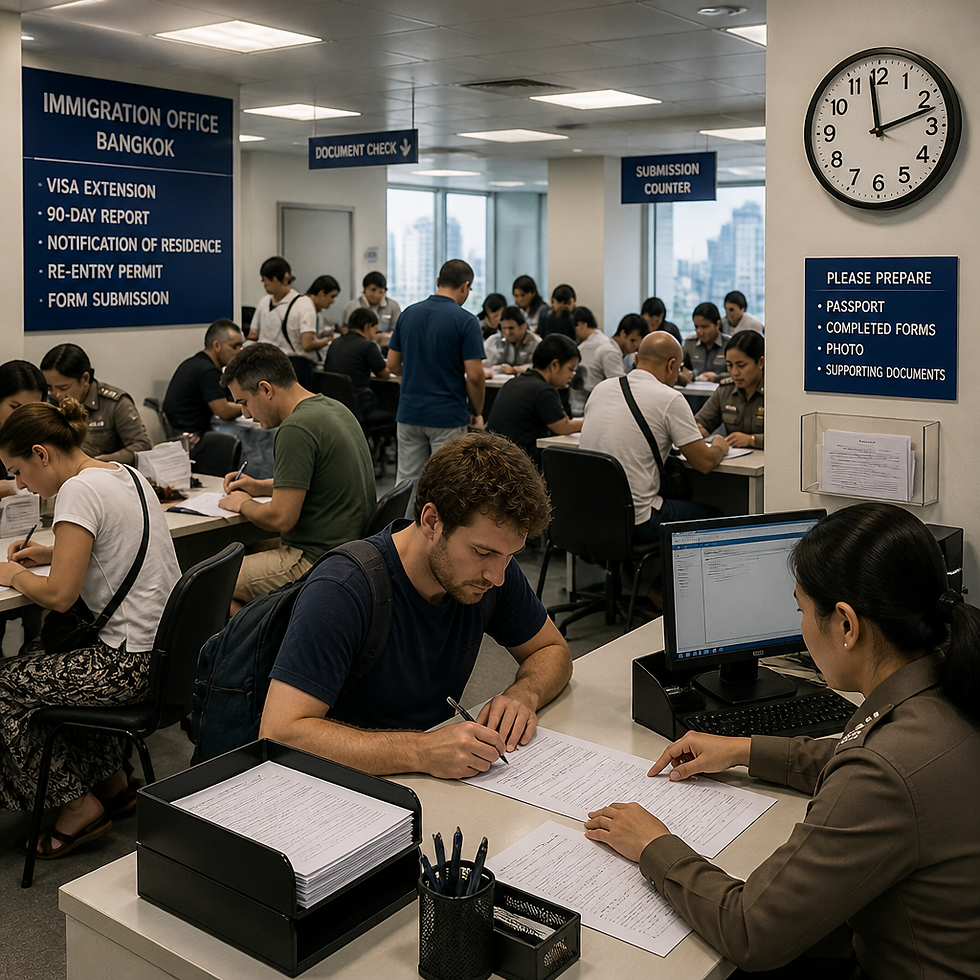
Thailand is one of the most accessible in-country extension destinations in all of Southeast Asia. The country grants a 60-day visa exemption to nationals of 93 countries, and that exemption is extendable at any Thai immigration office for an additional 30 days, giving you a maximum stay of 90 days without leaving the country.
The Documents You Need for a Thailand Extension
At your local immigration office, you will need to submit form TM.7 (the Application for Extension of Temporary Stay in the Kingdom), a copy of your passport bio page, a copy of your arrival stamp, a copy of your TM.30 (the residence notification form that your landlord or guesthouse is supposed to file when you check in), and a recent passport-size photograph. You will also pay an extension fee at the window.
The TM.30 is the document that most expats forget until the immigration officer asks for it. If your landlord has not filed it, many offices will accept a letter from your accommodation provider and a copy of your rental agreement as a substitute. Do not assume this will always work, it depends on the individual officer. The safer move is to confirm the TM.30 was filed within 24 hours of your arrival.
Practical Tips for Bangkok vs. Regional Offices
Bangkok's Chaeng Watthana immigration office is the main hub and is consistently crowded. Arrive before 8:00 a.m. if you want to be processed the same day. Regional offices in cities like Chiang Mai, Phuket, and Pattaya are often faster and more manageable. If you have the flexibility to travel, handling your extension in a regional office is frequently a smoother experience.
Pro tip: Bring two copies of every document even when the instructions say you only need one. Thai immigration staff regularly ask for an extra copy of your photo, your stamp, or your TM.7 form. Having it ready immediately avoids being sent to the photocopying shop across the street and losing your place in the queue.
The single most common reason Thailand extensions are delayed is not a visa problem, it is a TM.30 problem. Confirm your host filed it. If they did not, take care of it before you go to immigration, not on the same morning.
Malaysia Social Visit Pass Extension
Malaysia offers 90 days visa-free entry to most Western and African passport holders, which already makes it one of the most generous short-stay arrangements in the region. However, extending that stay in-country is not straightforward. The Social Visit Pass extension is granted on a discretionary basis and is typically reserved for exceptional circumstances such as illness, a family emergency, or a situation that made departure genuinely impossible.
What Malaysia Considers an Acceptable Reason for Extension
Malaysian immigration does not have a standard tourist extension program the way Thailand does. To apply at the Immigration Department (Jabatan Imigresen Malaysia), you need a documented reason. Medical reasons are the strongest, with a signed letter from a Malaysian-registered doctor being the most commonly accepted justification. If your reason is travel disruption (a cancelled flight, a political situation at home), you need a paper trail: airline confirmation of cancellation, embassy letters, or insurance documentation.
Showing up without documentation and hoping for the best is not a strategy that works here. Extensions granted without clear justification are rare, and rejection means you may be required to leave within a short window.
The Malaysia My Second Home Programme and Long-Term Options
If you are thinking about a longer stay in Malaysia, the MM2H (Malaysia My Second Home) programme is a legal pathway to a multi-year renewable residence pass. Requirements and financial thresholds for this programme have changed multiple times in recent years, so always verify the current financial requirements directly with the Malaysian Immigration Department or a licensed Malaysian immigration consultant before beginning that process.
Pro tip: Malaysia's immigration offices operate Monday through Friday with a midday break. The Kuala Lumpur main immigration office is widely known for long queues. Arrive when the office opens and have your documents pre-sorted in a folder rather than loose in your bag. Officers processing dozens of applicants per hour respond well to applicants who have made their job easier.
Vietnam Visa Extension and Renewal
Vietnam requires the most careful planning of any country in this guide when it comes to in-country stay extensions. The rules changed meaningfully in recent years, and the situation for travelers holding an e-visa is different from those who entered under a visa exemption arrangement.
The Distinction Between Extension and Renewal in Vietnam
Vietnam draws a formal distinction between visa extension (adding days to your current visa without issuing a new one) and visa renewal (issuing a new visa sticker with a fresh validity period). E-visa holders generally cannot extend their e-visa in-country. They must apply for a new e-visa, which can be done online through the official Vietnamese immigration portal, though you should expect processing time of several business days.
For travelers who entered under a bilateral visa exemption (typically 15 to 45 days depending on nationality and treaty arrangements), in-country extension is generally not available without a formal change of visa type, which requires either leaving the country or working through a licensed immigration agent who can process the paperwork through official channels.
Using a Licensed Agency in Vietnam
In Vietnam, licensed immigration and visa agencies occupy a more formal role than in most other Southeast Asian countries. Some agencies have official working relationships with local immigration authorities and can process in-country visa renewals for foreign nationals. The cost for this service is typically higher than a standard government fee and varies considerably depending on nationality, visa type, and how much time remains on your current visa. Treat any agency quoting unusually low fees with caution, and always ask to see their government license number before paying anything.
Indonesia Visa on Arrival Extension
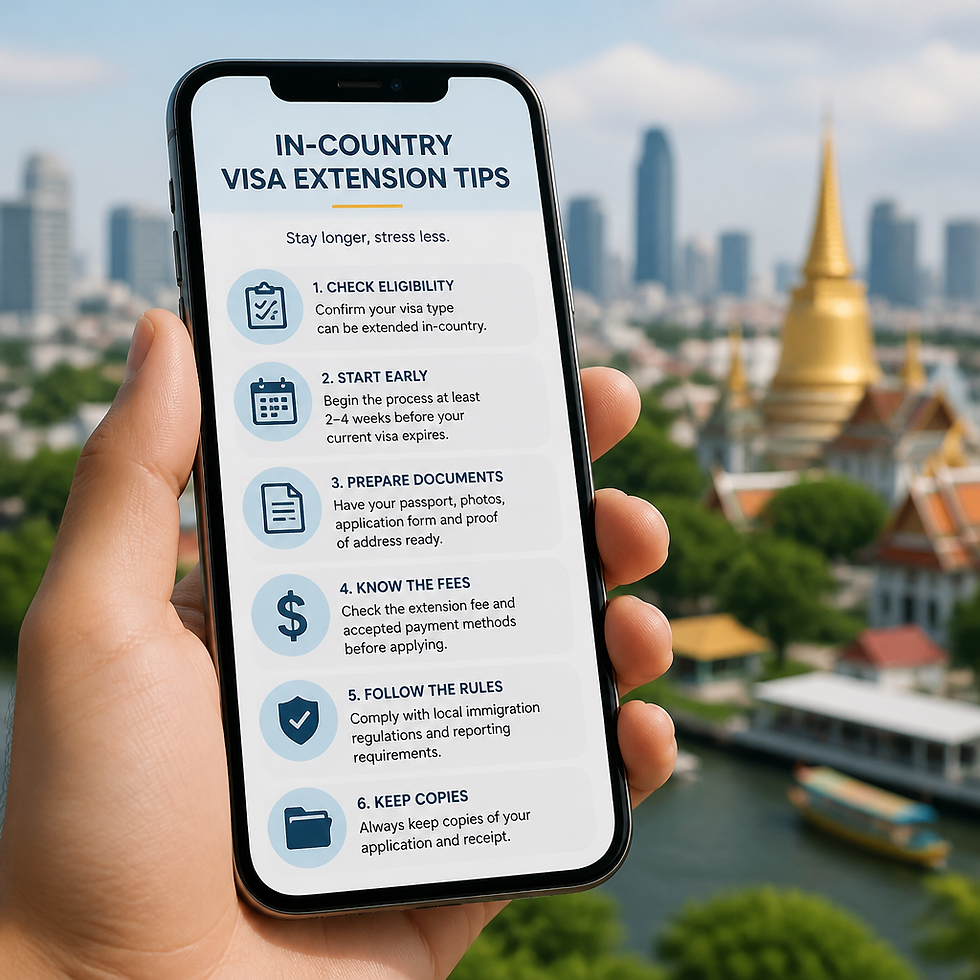
Indonesia's entry system for most visitors runs through the Visa on Arrival (VOA), which costs a set fee payable at the airport and gives you an initial 30-day stay. The VOA is extendable once for an additional 30 days, giving you a maximum tourist stay of 60 days.
The 2025 Rule Change You Need to Know About
Starting in mid-2025, Indonesia's Directorate General of Immigration implemented Circular Letter No. IMI-417.GR.01, which requires all foreigners to appear in person at their local immigration office to extend any visa or stay permit. The option of handling the VOA extension entirely online or through an agent without an in-person appearance was removed. This is a significant change from prior years and one that many expat resources written before mid-2025 do not reflect.
The documents required for a VOA extension include your passport with at least 6 months validity and blank pages, proof that you entered on a VOA (not a visa-exempt entry), a return or onward travel ticket, a completed extension application form (available at the immigration office), and the extension fee. In Bali, the main immigration offices handling tourist visa extensions are located in Denpasar, Jimbaran, and Singaraja.
Longer Stays in Indonesia: The Social and Cultural Visa
If 60 days is not enough, Indonesia offers a Social and Cultural Visa (B211A) that allows for a longer initial stay with multiple extension options, cumulatively allowing stays of up to 180 days. This visa type requires sponsorship from an Indonesian sponsor (often a company, language school, or cultural organization) and has different processing requirements. It is not a tourist visa and should not be treated as one. However, for Black expats who plan to stay in Indonesia for several months, it is a legitimate and well-used pathway.
Philippines Visa Extension Overview
The Philippines runs one of the most streamlined tourist visa extension systems in Southeast Asia. Most visitors enter with an initial 30-day stay and can extend that stay in increments of up to 2 months at a time at any Bureau of Immigration office or accredited travel agency. Extensions can be stacked up to a maximum cumulative stay of 36 months, though the cost per extension increases after the first year of total stay.
The process involves submitting your passport, an extension application form, and the applicable fee. Processing is typically completed the same day at major Bureau of Immigration offices in Manila, Cebu, and Davao. Smaller provincial offices may take longer. There is no requirement to prove a specific reason for wanting to stay longer, unlike Malaysia. For expats who value predictability and ease, the Philippines offers the most straightforward in-country extension experience of any country in this guide.
Pro tip: In the Philippines, extensions must be filed before your current authorized stay expires. If you overstay even by one day, you will be assessed an overstay fine before any new extension is processed. That fine must be paid at the Bureau of Immigration before you can extend or depart. Avoid this entirely by filing your extension at least one week before your stamp expires.
Comparing In-Country Extension Options
The table below compares the core in-country extension options across the five main Southeast Asian destinations for Black expats. Use it as a reference point, then verify current fees and processing times with official immigration sources or a licensed local agent, since fee structures in particular tend to shift.
Country | Extension Availability and Process | Key Limitations |
|---|---|---|
Thailand | 30-day extension on 60-day exemption. Apply at any immigration office with TM.7 form and supporting documents. Processed same day in most cases. | One-time extension only on the exemption. Overstaying by even one day triggers a daily fine. TM.30 is commonly overlooked and causes delays. |
Malaysia | Discretionary Social Visit Pass extension at Immigration Department. Requires documented exceptional circumstances. | Not a standard tourist extension program. No documentation means near-certain rejection. Most visitors must exit if they want more time. |
Vietnam | E-visa renewal available online through official portal. In-country renewal via licensed agent possible in some cases for other entry types. | Standard e-visa extension is not available. New e-visa application required. Agent-based renewal costs are high and not government-regulated in terms of price. |
Indonesia | VOA extendable once for 30 days at local immigration office. In-person appearance mandatory since mid-2025. | One extension only on VOA. Maximum 60 days on tourist track. Longer stays require a different visa type with a local sponsor. |
Philippines | Extensions available in 2-month increments at Bureau of Immigration. No reason required. Can stack up to 36 months total. | Per-extension cost increases after 12 months of cumulative stay. Any overstay, even a single day, generates a mandatory fine before extension is processed. |
Common Mistakes That Get Expats Rejected
Across all five countries, the same cluster of mistakes appears repeatedly in expat community reports. Understanding them in advance is how you avoid becoming one of the cautionary stories shared in WhatsApp groups after the fact.
Showing up too close to expiry. Immigration offices in Southeast Asia take seriously the gap between your application date and your visa expiry date. Appearing on the day of expiry in Thailand or Indonesia is seen as a sign of bad planning or an attempt to stay beyond your authorized period. Aim to apply at least 7 days before your stamp expires, and 14 days if your schedule allows it.
Relying on outdated information. Visa rules in Southeast Asia change frequently and sometimes without significant advance notice. Indonesia's mid-2025 in-person mandate is a perfect example. A guide written in 2024 would have told you that online extension was sufficient. Acting on that information in late 2025 or 2026 would have resulted in a rejected application and potential overstay complications. Always verify current rules through an official government immigration portal or a licensed local agent before submitting anything.
Not having housing documentation ready. Every country in this guide requires some form of current address documentation. This means a rental agreement, a hotel booking confirmation, or a host's signed letter. Black expats who are house-sitting, staying with local contacts, or in informal housing arrangements need to have this documentation formalized before they walk into an immigration office. An officer who cannot confirm where you are sleeping is an officer who has a reason to decline your application.
Using unlicensed agents. Particularly in Vietnam and Indonesia, unlicensed intermediaries promise fast processing and deliver nothing except a smaller bank balance and a ticking clock. A common pattern is collecting payment, providing no documentation, and becoming unreachable as the visa expiry date approaches. If you are going to use an agent, verify their license, read recent reviews from verifiable sources, and never pay the full fee upfront.
Frequently Asked Questions
Can I extend my visa in Southeast Asia without speaking the local language?
Yes, in all five countries covered here, immigration offices in major cities handle foreign nationals routinely and staff at least some English-speaking officers. That said, bringing a printed, clearly organized application packet reduces your dependence on verbal communication and speeds up the process considerably. In smaller provincial offices in Vietnam or Indonesia, having a translator or using a licensed agent is genuinely helpful.
What happens if I overstay my visa in Southeast Asia?
Every country in this guide has penalties for overstay that range from daily fines to entry bans. Thailand charges a daily fine for each day of overstay and can impose a ban ranging from 1 to 10 years depending on length of overstay. The Philippines requires all overstay fines to be paid before any further extension or departure is processed. Indonesia and Vietnam have both imposed entry bans on repeat overstay offenders. In short, overstaying is never worth the risk, and the in-country extension systems described here exist specifically to help you avoid it.
Is it safe for Black Americans and Black expats to visit Southeast Asian immigration offices alone?
Immigration offices are bureaucratic environments, not hostile ones. The professional conduct of officers varies, as it does in every country in the world, but the process itself is the same for everyone. Bringing your documentation organized and complete is the single biggest factor in how smoothly your interaction goes. If you have concerns about a specific office or encounter, connecting with local expat community members who have recent firsthand experience is the best way to calibrate your expectations.
Do I need to leave Southeast Asia and re-enter to reset my visa?
Not always. Thailand, Indonesia, and the Philippines all offer meaningful in-country extension options that allow you to stay legally without a border run. Malaysia and Vietnam are more restrictive, and for longer stays in those countries, a departure and re-entry or a formal long-term visa application is often the more practical path. The key is knowing which option is available to you before your current stamp expires, not after.
Can I work remotely on a tourist visa extension in Southeast Asia?
This is one of the most misunderstood areas in expat visa discussions. A tourist visa extension authorizes you to be present in the country, not to work in it. If you are earning income while on a tourist visa extension, you are technically in violation of the visa conditions in every country covered here. Countries like Thailand have introduced specific digital nomad and long-term residence visa products for remote workers. If remote work is a significant part of your time in Southeast Asia, researching those specific products is worth the effort rather than operating in a grey area that can result in visa cancellation, fines, or a ban.
How do I find a trustworthy immigration agent in Southeast Asia?
Start with verification rather than reputation. In Indonesia, agents should be licensed by the Directorate General of Immigration. In Vietnam, agencies operating visa services for foreigners should be registered with local authorities. Beyond license checks, look for agents who provide a written service agreement, quote a fee upfront, and can provide recent client references in your specific nationality category. Avoid anyone who guarantees outcomes on discretionary decisions, no immigration agent has the authority to guarantee an officer's approval.
Have you navigated a visa renewal in Southeast Asia as a Black expat? Share your experience in the comments, what worked, what surprised you, and what you wish someone had told you before you walked into that immigration office.
References
Thailand 60-day visa exemption extension rules and Tourism Authority of Thailand guidance
Vietnam visa extension and renewal process explained by an immigration services provider
Bali and Indonesia visa extension guide covering VOA rules and 2025 in-person requirements
Malaysia visa extension and Social Visit Pass rules for foreign nationals
Step-by-step breakdown of the Thailand tourist visa extension paperwork process


Comments